

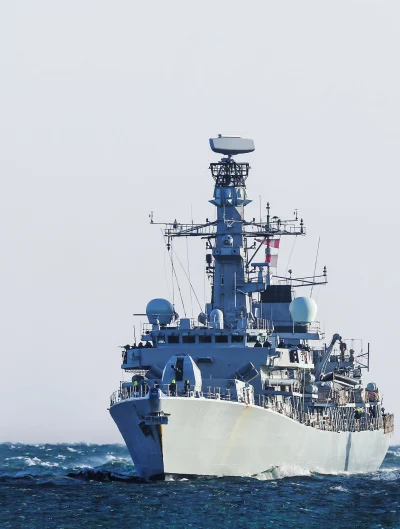

Defense manufacturing has always pushed forming technologies to their limits. Unlike commercial production environments that often prioritize high-volume output, defense programs demand flexibility, precision, and the ability to manufacture increasingly complex components in relatively small quantities. Aircraft structures, propulsion systems, military vehicles, and next-generation defense platforms all require lightweight, high-strength parts that must meet strict performance and quality standards.
For decades, Beckwood’s TRIFORM hydroforming technologies have helped aerospace, defense, and space manufacturers meet these challenges. From rapid prototyping programs to full-scale production environments, TRIFORM systems enable manufacturers to produce complex metal components with lower tooling costs, faster development cycles, and greater design flexibility than traditional forming methods. Beckwood’s experience extends beyond supplying equipment. The company engineers complete hydroforming solutions tailored to the unique demands of defense manufacturing, helping customers solve problems that conventional forming technologies often cannot address.
Why Defense Manufacturers Continue to Turn to Hydroforming
Many military manufacturers face a common challenge: producing highly specialized components without the production volumes needed to justify expensive hard tooling.
Defense programs frequently evolve throughout development and qualification phases. Engineering teams may revise component designs multiple times before production begins, making traditional matched-die stamping an expensive and inflexible option. At the same time, aerospace and defense parts often feature complex geometries, lightweight structures, and advanced materials that can be difficult to form consistently using conventional methods.
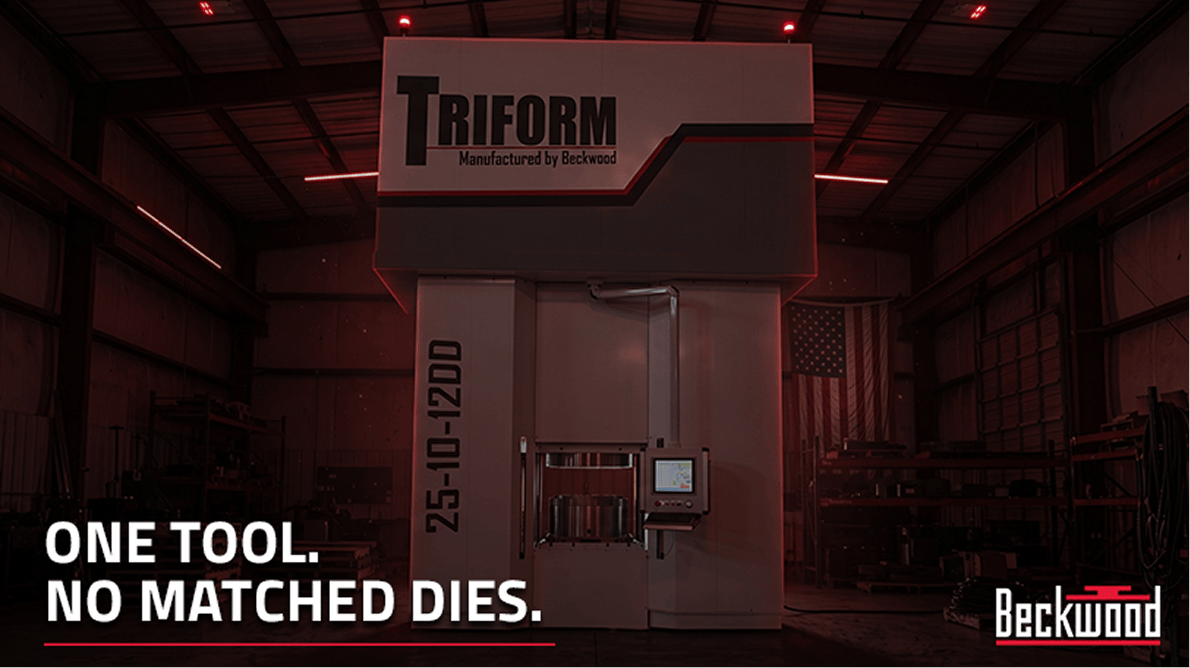
TRIFORM Sheet Hydroforming addresses these challenges through a process that uses hydraulic fluid pressure and a flexible diaphragm to form metal against a single rigid tool. Because only one tool is required, manufacturers can significantly reduce tooling costs while maintaining the flexibility needed to support low-volume production, rapid design changes, and prototype development.
This combination of precision and adaptability has made hydroforming an important manufacturing technology throughout the aerospace and defense sectors.
Forming complex aerospace and defense components?
Discover what TRIFORM hydroforming can do for your application.
How TRIFORM Sheet Hydroforming Supports Defense Programs
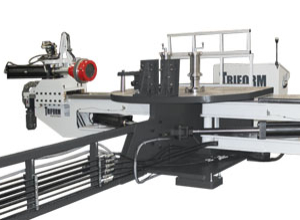
TRIFORM sheet metal hydroforming systems thrive in the exact environments that characterize modern defense manufacturing: low-volume, high-mix production where tooling changes are frequent and manufacturing processes are continually refined. Beckwood’s TRIFORM engineers have developed specialized systems that use a pressurized rubber diaphragm and a single, unmated tool to create near-net-shape parts in a single cycle.
The technology provides several advantages that are particularly valuable for military manufacturers:
Reduced Tooling Costs
Traditional stamping operations often require expensive matched die sets. TRIFORM hydroforming eliminates the need for these complex tooling systems by using a single rigid tool, dramatically reducing upfront tooling investment. This becomes especially important for defense programs where production quantities may remain relatively low throughout a product’s lifecycle.
Faster Development Cycles
Prototype development and qualification testing are critical phases of many defense programs. Because hydroforming requires less tooling and supports rapid design modifications, manufacturers can move from concept to production faster while reducing the costs associated with engineering revisions.
Superior Part Quality
Hydraulic pressure is distributed evenly across the workpiece during the forming cycle, helping manufacturers produce highly consistent parts with excellent surface finishes. The process minimizes scratches, tool marks, wrinkles, and material defects that often require secondary finishing operations.
Enhanced Material Performance
Many aerospace and defense applications rely on advanced materials such as titanium, stainless steel, Inconel, Hastelloy, and nickel-based alloys. TRIFORM systems provide the process control necessary to form these materials while maintaining dimensional accuracy and structural integrity.
Real-World TRIFORM Applications in Aerospace and Defense
What separates Beckwood from many equipment manufacturers is its extensive experience solving complex aerospace and defense forming challenges.
One notable example is Beckwood’s custom TRIFORM 42-10-12 deep draw hydroforming machine developed for aerospace research and development applications. As the largest standard-configuration deep draw machine in its class, the system features a maximum blank diameter of 42 inches and can apply up to 10,000 PSI of uniform forming pressure.
For this particular customer, Beckwood engineered a customized solution with more than 4,300 tons of lower punch force, more than double the standard configuration, to better handle high-strength aerospace alloys. The machine was also designed to integrate with the customer’s existing tooling, allowing them to modernize legacy hydroforming operations without replacing their entire tooling inventory.
Another example demonstrates Beckwood’s ability to solve challenges that other manufacturers cannot. A leading space launch vehicle manufacturer approached multiple press builders seeking a solution for producing a large aerospace component as a single piece.
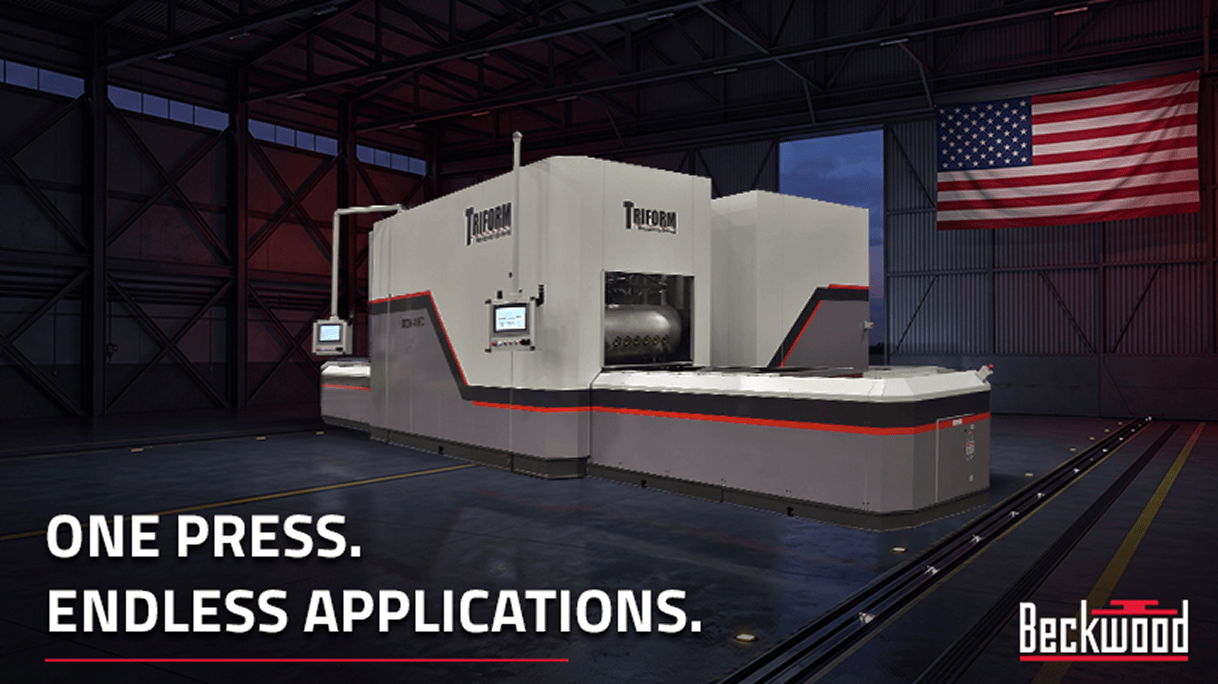
Other manufacturers proposed splitting the part into multiple sections and welding them together. Beckwood instead engineered the custom TRIFORM 68-10FC, now recognized as the world’s largest circular fluid cell hydroforming machine. The system can form blanks up to 68 inches in diameter while delivering up to 10,000 PSI of pressure, enabling the customer to produce the component as a single structure without compromising part integrity.
Projects like these illustrate why TRIFORM technology has become an important resource for aerospace, defense, and space manufacturers tackling advanced forming applications.
Need a custom hydroforming press for a unique manufacturing challenge? Let's build the right solution together.
Deep Draw Hydroforming
for Advanced Defense Components
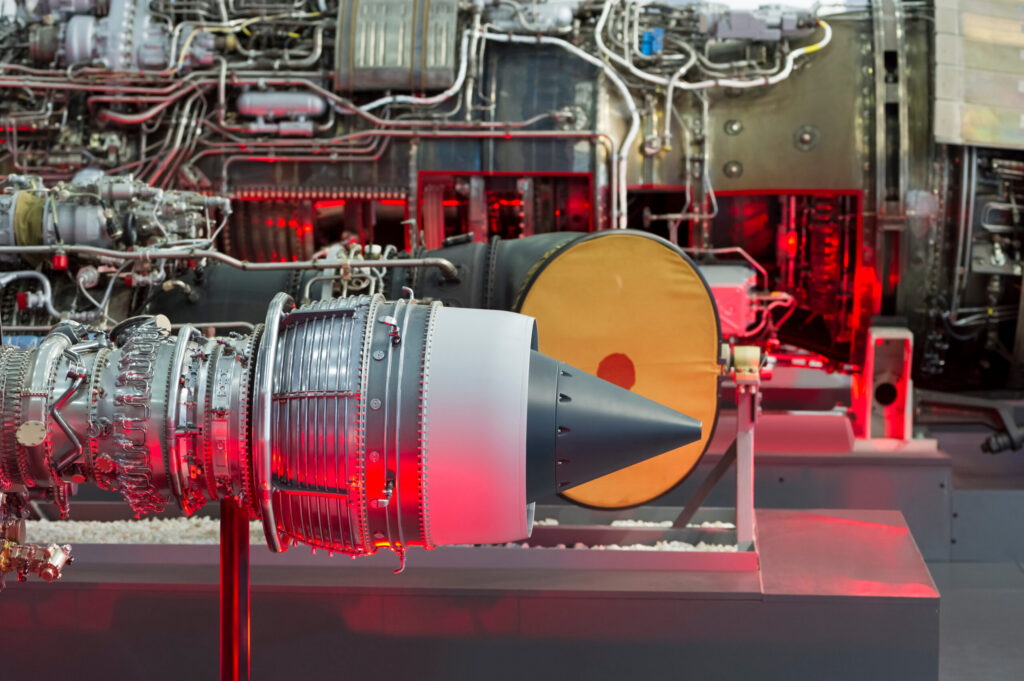
Many defense applications require components that exceed the capabilities of traditional sheet metal forming processes. Aerospace engine housings, structural aircraft components, and specialized military hardware often involve deep geometries that can be difficult to manufacture consistently.
TRIFORM deep draw hydroforming systems utilize an elastomeric diaphragm that acts as a universal female die. This approach can reduce tooling costs by as much as 90% while delivering exceptional control over material flow. Pressure and punch position are tightly controlled throughout the forming cycle, helping manufacturers eliminate wrinkles, tears, and material thinning while producing smooth, uniform parts that often require no secondary finishing.
The result is a highly repeatable process capable of supporting both prototype development and production manufacturing for complex aerospace and defense applications.
Beyond Hydroforming: Beckwood's Broader Defense Manufacturing Expertise
While TRIFORM Sheet Hydroforming remains a core technology for defense manufacturing, Beckwood’s capabilities extend far beyond hydroforming alone.
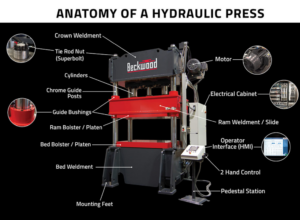
The company designs and manufactures custom hydraulic presses, hot forming systems, superplastic forming equipment, ring expanders, compression molding presses, and linear servo press technology specifically engineered for demanding aerospace and military applications. Many defense manufacturers require highly customized equipment that cannot be addressed through standard machine configurations. Beckwood’s engineering team routinely develops application-specific solutions featuring heated platens, multi-action press beds, gib-guided rams, advanced controls, and automation integration.
This ability to engineer complete manufacturing solutions allows Beckwood to support a wide range of defense production requirements, from forming titanium aircraft structures and aerospace engine components to manufacturing composite parts and high-performance military hardware.
The Future of TRIFORM Hydroforming in Defense Manufacturing
Defense manufacturers continue to face growing pressure to accelerate development timelines, reduce production costs, and incorporate increasingly advanced materials into next-generation platforms.
As aircraft modernization programs, autonomous systems, space initiatives, and advanced defense technologies evolve, manufacturers need forming solutions that can adapt quickly without sacrificing quality. TRIFORM Sheet Hydroforming remains uniquely positioned to support these objectives through its combination of tooling flexibility, precision forming, and advanced material capabilities.
For decades, Beckwood has helped aerospace and defense manufacturers overcome some of the industry’s most demanding forming challenges. From prototype development and aerospace R&D programs to record-breaking hydroforming systems built for space launch applications, TRIFORM technology continues to demonstrate why it remains one of the most effective forming solutions available for modern defense manufacturing.
Ready to reduce tooling costs and accelerate development? Contact our team to discuss your next project.