
Forging
Home / Press Applications / Forging
Create Performance Parts With A Heated Forging Press
Forging is a metal forming process that shapes material through compressive force to produce parts with improved strength, grain structure, and mechanical properties. Unlike machining or casting, forging refines the internal grain flow of the material, resulting in superior fatigue resistance and structural integrity. Modern forging processes use controlled hydraulic press systems to produce consistent, repeatable parts across a wide range of materials and geometries. Forging is commonly used in aerospace, defense, mining, energy, consumer hand-tools and other industrial applications where performance and reliability are critical.
Forging Process Considerations
Forging press design is driven by material type, part geometry, forming temperature, and production objectives. These considerations influence press tonnage, frame design, thermal systems, tooling configuration, and automation requirements.
Open Die vs. Closed Die Forging
Open Die Forging
Open die forging uses tooling that does not fully enclose the material. This process is typically used for simpler shapes, larger parts, or lower production volumes. Secondary machining is often required to achieve final dimensions.
Closed Die Forging
Closed die forging fully encloses the material within matched tooling, allowing for more complex geometries, tighter tolerances, and reduced secondary machining. Tooling costs are higher, but part repeatability and material utilization are improved.
Hot vs Cold Forging
Hot Forging
Hot forging is performed at elevated temperatures to increase material ductility and reduce required forming force. This process supports complex geometries and larger deformation but requires integrated heating systems, thermal controls, and additional safety considerations.
Cold Forging
Cold forging is performed at or near ambient temperature and is typically used for simpler geometries and higher-volume production. Higher tonnage is required, and material selection must account for ductility and strain hardening behavior.
Force, Stroke, & Energy Requirements
Forging applications often require high tonnage and robust energy delivery throughout the stroke. Press sizing must account not only for peak force but also for available stroke, energy absorption, and repeatability under continuous high-load conditions.
Tooling, Flash, & Secondary Operations
Tooling design influences material flow, flash formation, and final part geometry. Flash removal, trimming, and downstream machining requirements should be considered as part of the overall forging process strategy.
Automation, Safety, & Environment
Forging environments often require automated material handling, die loading, and scrap removal to improve safety and throughput. Press systems must be designed to withstand harsh conditions such as heat, scale, debris, and vibration.
Beckwood Forging Solutions
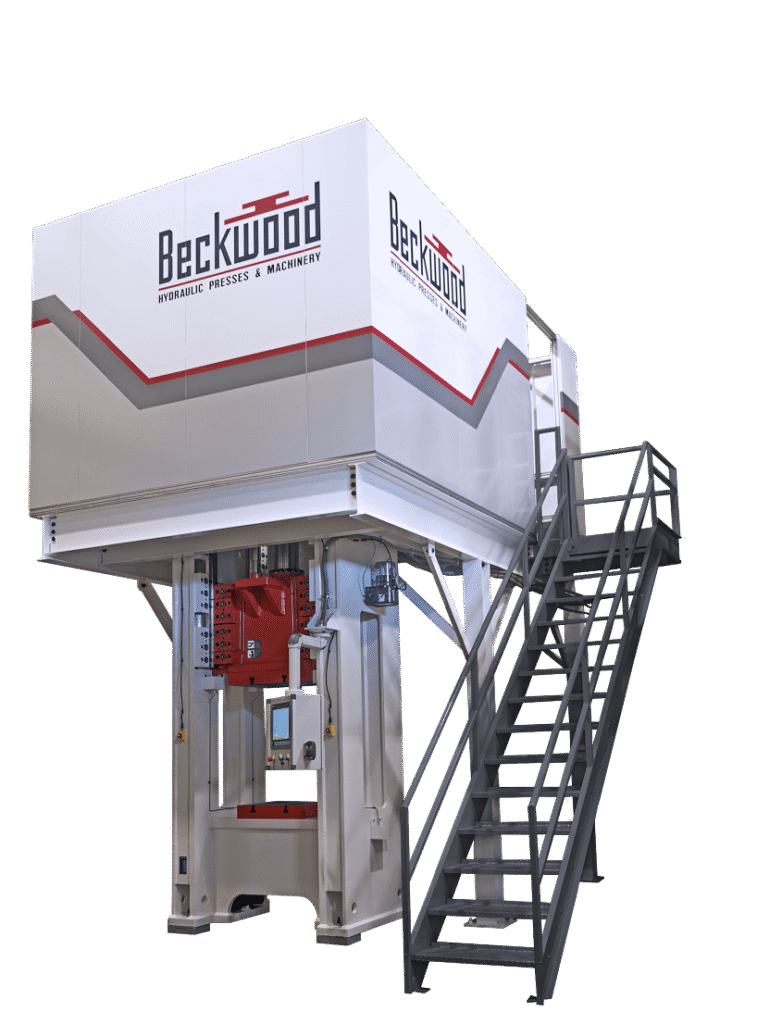
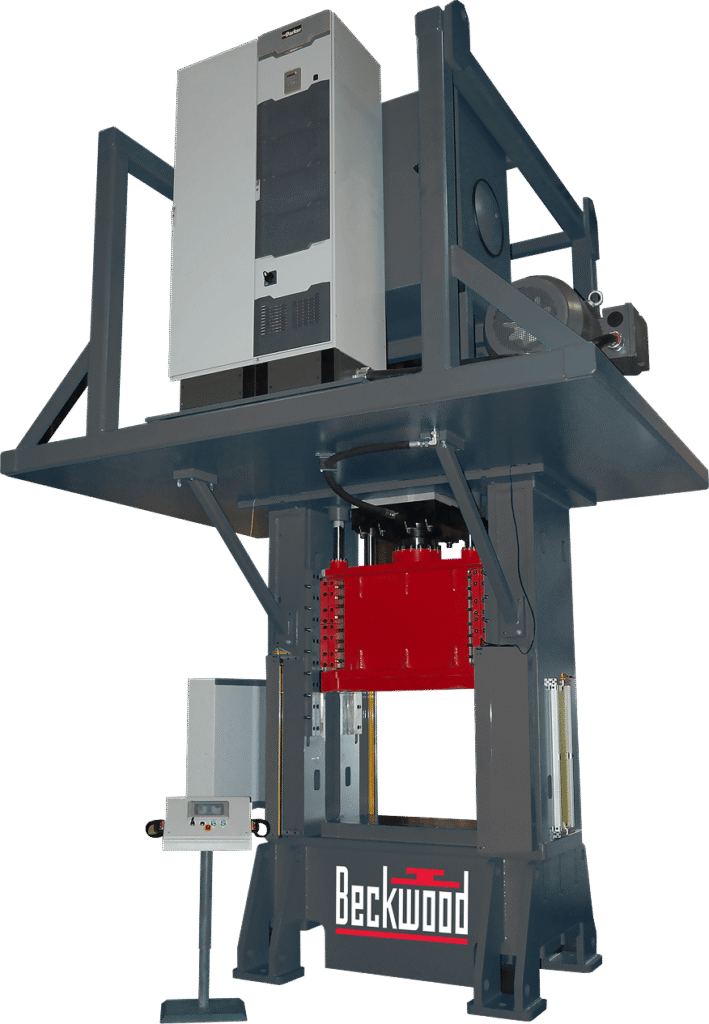
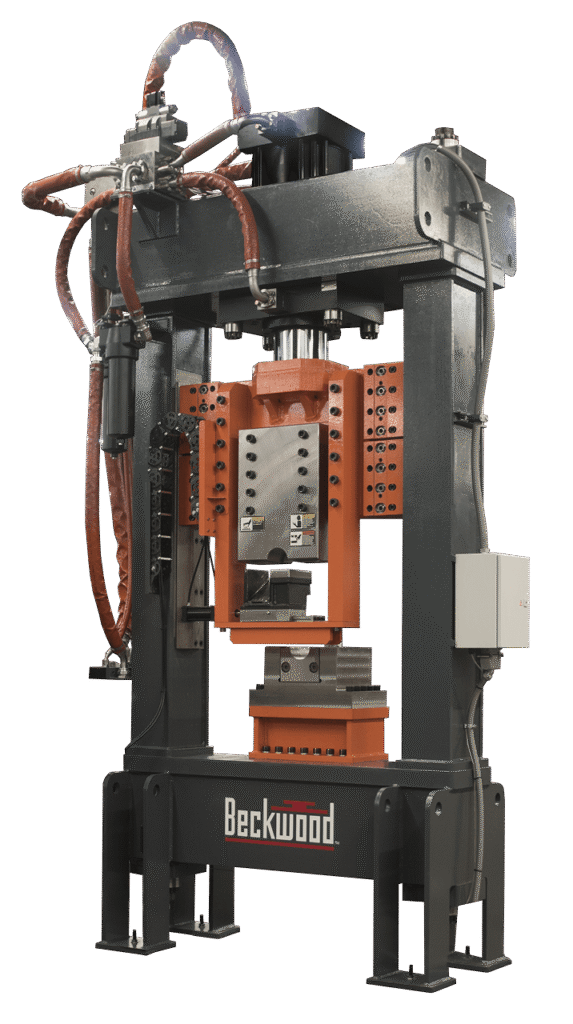
Beckwood engineers and manufactures custom hydraulic forging press systems designed to support both open and closed die forging applications. Each system is engineered around the specific material, tooling, and production requirements of the application.

Custom Hydraulic Forging Presses
Forging presses are custom designed to deliver the required tonnage, stroke, and rigidity for demanding forging operations. Structural design prioritizes durability, alignment, and long-term reliability in high-load environments.

Integrated Heating & Thermal Control
Optional heated platens, die heating, and thermal management systems support hot forging applications and help maintain consistent forming conditions throughout the production cycle.

Precision Controls & Process Repeatability
Advanced press controls allow programmable motion profiles, force monitoring, dwell control, and repeatable cycle sequencing to improve consistency and reduce operator dependency.

Automation & Material Handling Integration
Forging press systems can be integrated with automated billet handling, die loading, part transfer, trimming, and scrap removal systems to support safer and more efficient production workflows.

Safety Systems & Guarding
Forging presses incorporate safety guarding, light curtains, area scanners, and interlocked access systems designed for high-force, high-temperature environments.
Explore Heated Forming Methods
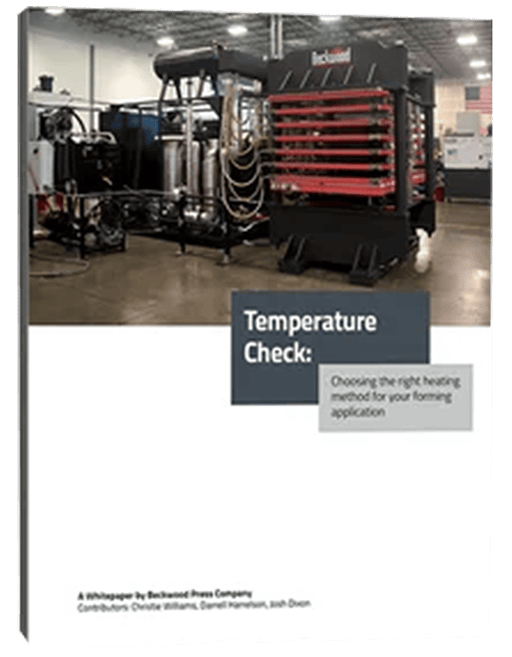
Forging is just one way of utilizing heat in the manufacturing process. Discover the various types of heat control utilized in press design in this whitepaper to understand which method is best suited to your requirements.
Forging FAQs
What materials are commonly forged using hydraulic presses?
Hydraulic forging presses are commonly used for steel, aluminum, titanium, and specialty alloys, depending on application requirements and forming temperature.
When does hydraulic forging make sense compared to mechanical or hammer forging?
Hydraulic forging is often preferred for applications requiring controlled force, longer dwell times, larger parts, or improved process control compared to hammer-based systems.
Is forging suitable for low-volume production?
Yes. Forging can be used for both low- and high-volume production, though tooling cost and setup requirements must be evaluated relative to part volume.
Can forging presses be automated?
Yes. Modern forging presses are frequently integrated with automated handling, trimming, and inspection systems to improve safety and throughput.
Can Beckwood customize a forging press for my application?
Yes. Beckwood designs custom hydraulic forging press systems tailored to specific materials, part geometries, forming temperatures, production volumes, and facility constraints.