
Punching & Blanking
Home / Press Applications / Punching & Blanking
What is Punching/Blanking?
Punching and blanking are sheet material processing operations used to create holes, cutouts, slots, or finished profiles by shearing material with a punch and die. These processes are fundamental to manufacturing across aerospace, automotive, defense, energy, construction, appliance, and industrial applications, where dimensional accuracy and repeatability are critical. Punching produces a finished sheet with material removed, while blanking produces the removed piece as the finished part. Both processes require precise force control, rigid press structures, and repeatable motion to ensure part quality and tooling life.
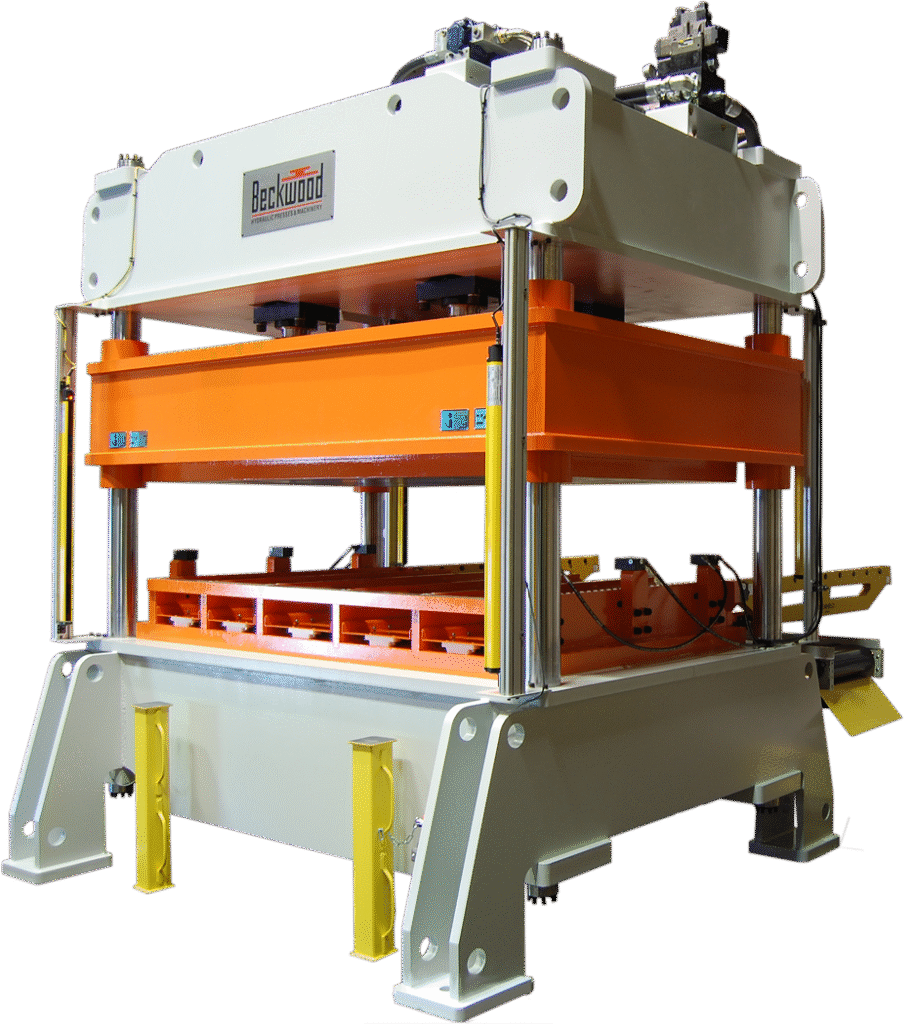
Punching & Blanking Press Design Factors
Punching press and blanking press design is driven by tooling design, material type, thickness, feature geometry, and production rate requirements. These considerations influence press tonnage, stroke, speed, guidance, and system configuration.
Material Type & Thickness
Material selection directly impacts required punching force, tooling design, and press capacity. Aluminum, carbon steel, stainless steel, high-strength alloys, plastics, and composite materials all exhibit different shear characteristics that must be accounted for when sizing the press and tooling.
Hole Size, Feature Geometry & Tooling Layout
Hole diameter, perimeter length, slot geometry, and feature spacing influence required tonnage and press guidance requirements. Tooling layout can introduce uneven or off-center loading conditions that must be considered during press design to maintain alignment and prevent premature wear.
Punching vs. Blanking Requirements
While punching and blanking use similar tooling and press mechanics, the finished part requirement differs. Punching prioritizes hole quality and positional accuracy in the sheet, while blanking prioritizes edge quality, flatness, and dimensional consistency of the removed part. These requirements can influence press speed, motion profile, and scrap handling strategy.
Stroke, Speed & Short-Stroking Capability
Production rate requirements influence press speed and stroke length. Hydraulic and servo-electric presses allow for short-stroking when designed appropriately, where the ram retracts only as far as necessary to clear the tooling. This can significantly reduce cycle time but very high volume punching or blanking will typically utilize a mechanical press.
Breakthrough Shock & Vibration
Punching and blanking operations generate breakthrough shock as material fractures. Managing this shock is critical to protecting tooling, maintaining parallelism, and extending press life. Shock control strategies may include motion profile optimization, structural rigidity, and optional shock or energy-absorbing features.
Feeding, Scrap Handling & Automation
Punching and blanking operations may involve manual loading, coil feeding, transfer systems, or robotic handling. Scrap removal, slug management, and part ejection must be considered early to maintain productivity and operator safety.
Punching & Blanking Press Options
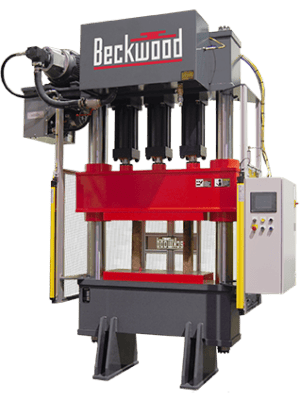
Beckwood engineers and manufactures custom hydraulic and servo-electric punching and blanking press systems designed to support precision cutting operations across a wide range of materials and production environments.

Hydraulic Punching & Blanking Presses
Hydraulic presses deliver full tonnage at any point in the stroke, making them well suited for punching and blanking applications requiring controlled force, short-stroking, and flexible motion profiles. These systems are commonly used for precision, lower to mid-volume production.

Servo-Electric Punching Presses
Servo-electric presses ranging from 2.5 – 500 tons offer high repeatability, precise motion control, and energy efficiency. They are well suited for medium to higher speed punching applications where clean operation, consistency, and programmable stroke profiles are required.

Rigid Frame, Precision Guidance & Shock Management
Rigid press structures and precision guidance systems are engineered to maintain alignment under full and off-center loading, with optional shock management features and dampeners for high-impact punching and blanking operations.

Automation & Material Handling Integration
Punching and blanking presses can be integrated with coil feeds, straighteners, scrap chutes, conveyors, transfer systems, and robotic handling to support efficient, automated production lines.
Punching & Blanking FAQ
What is the difference between punching and blanking?
Punching produces a finished sheet with material removed, while blanking produces the removed piece as the finished part. Both processes use similar tooling but differ in part quality requirements and scrap handling.
What materials can be punched or blanked?
Punching and blanking are commonly used with aluminum, carbon steel, stainless steel, high-strength alloys, plastics, and composite materials, depending on application requirements.
Why are hydraulic or servo-electric presses often used instead of mechanical presses?
Hydraulic and servo-electric presses provide full tonnage throughout the stroke, programmable motion profiles, and short-stroking capability, which can improve flexibility, repeatability, and productivity.
How is breakthrough shock managed in punching and blanking operations?
Breakthrough shock can be managed through press rigidity, optimized motion profiles, active leveling control systems, and optional shock-absorbing features to protect tooling and extend press life.
Can punching and blanking presses be automated?
Yes. Punching and blanking presses are frequently integrated with coil feeding, scrap handling, and automated part transfer systems to support high-throughput production.
Can Beckwood customize a punching or blanking press for my application?
Yes. Beckwood specializes in custom-engineered punching and blanking press solutions tailored to specific materials, tooling layouts, production volumes, and facility requirements.