

Hydroforming
Machinery
Home / Product Lines / Triform Presses
Applications
Modernize Your Forming Operations With TRIFORM
Ideal for High Mix, Low Volume Production
TRIFORM sheet hydroforming machines are frequently used in the aerospace & defense industry where high-mix, low volume production is common. The uniform pressure exerted by the diaphragm is optimal for creating complex geometric shapes which are difficult using traditional forming methods. Parts that normally require multiple steps or expensive progressive dies can often be formed in a single cycle through sheet hydroforming.
Hydroforming History
Hydroforming has become a broadly used term in the manufacturing landscape today. At a high level, this can be broken down into two common categories: (1) tube hydroforming and (2) sheet hydroforming.
The history of tube hydroforming traces back to the early 1900s when an initial patent proposed using fluid, rather than interlocking mandrels, to form cylindrical parts. Although this patent was never truly utilized for commercial use, advancements came decades later in the 1940s to create seamless copper fittings using internal pressure and axial load. This same process, initially used for plumbing fittings, closely resembles modern tube hydroforming today which has expanded into wide use specifically in the automotive industry.
Sheet hydroforming became industrialized in the late 1940s into the early 1950s when Cincinnati Milacron (Cincinnati Milling Machine Company, founded by Geier and Holtz in 1889) introduced the deep draw hydroform machine, which simplified the forming process by using one tool instead of two. This process also provided the ability to form more complex parts in a single operation vs several iterations with more conventional methods. Sheet hydroforming became a staple in the aerospace and defense sectors, along with the lighting industry for reflectors, as it was ideal for high-mix low-volume production environments due to the savings in tooling costs, among other benefits. By the mid-1970s, Verson Allsteel Press Company acquired the Milacron hydroform business and made moderate improvements with the equipment, delivered as Verson Hydroform. Verson also played a major role in the development of the fluid cell sheet hydroforming equipment as an improved alternative to rubber pad forming. However, the manufacturing of new hydroforms in the United States came to a halt shortly thereafter until Beckwood launched the Triform product line in the early 2000’s, focused on modernizing the technology for consistent and reliable results.
Explore Triform Models
Additional Options
Fluid cell
- Dual Shuttle
- Increased Forming Pressure
- Increased Tray Depth
- Custom Sizes Available Upon Request
Deep Draw
- Increased Lower Punch Force
- T-Table Tool Change
- Tool Adapters for Existing Tooling
- Increased Forming Pressure
- Punch Support Pins
- Barcode Scanner for Recipe Loading
- Custom Sizes Available Upon Request
Fluid Cell
| Model | Forming Area | Max Forming Pressure (PSI) | Max Tool Height / Tray Depth |
|---|---|---|---|
| 16-5FC | 16" | 5,000 | 5" |
| 24-5FC | 24" | 5,000 | 5" |
| 42-5FC | 42" | 5,000 | 5" |
| 3648-10FC | 36"x48" | 10,000 | 8" |
| 3678-10FC | 36"x78" | 10,000 | 8" |
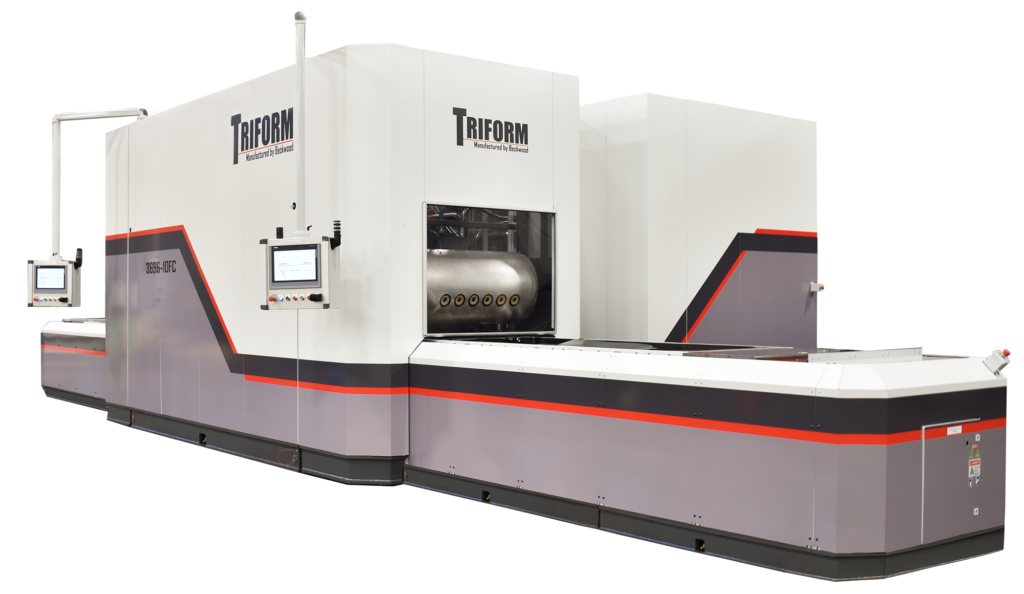
| 3696-10FC | 36"x96" | 10,000 | 8" |
| 36120-10FC | 36"x120" | 10,000 | 8" |
Deep Draw
| Model | Max Blank Diameter | Max Forming Pressure (PSI) | Draw Depth | Max Punch Diameter | Punch Force | Pit Depth |
|---|---|---|---|---|---|---|
| 610-20-3DD | 6" x 10" | 20,000 | 3" | 3"x7" | 120T | N/A |
| 12-15-7DD | 12" | 15,000 | 7" | 8" | 280T | N/A |
| 16-10-7DD | 16" | 10,000 | 7" | 12" | 370T | N/A |
| 16-15-7DD | 16" | 15,000 | 7" | 12" | 600T | 19" |
| 20-10-10DD | 20" | 10,000 | 10" | 15" | 490T | 20" |
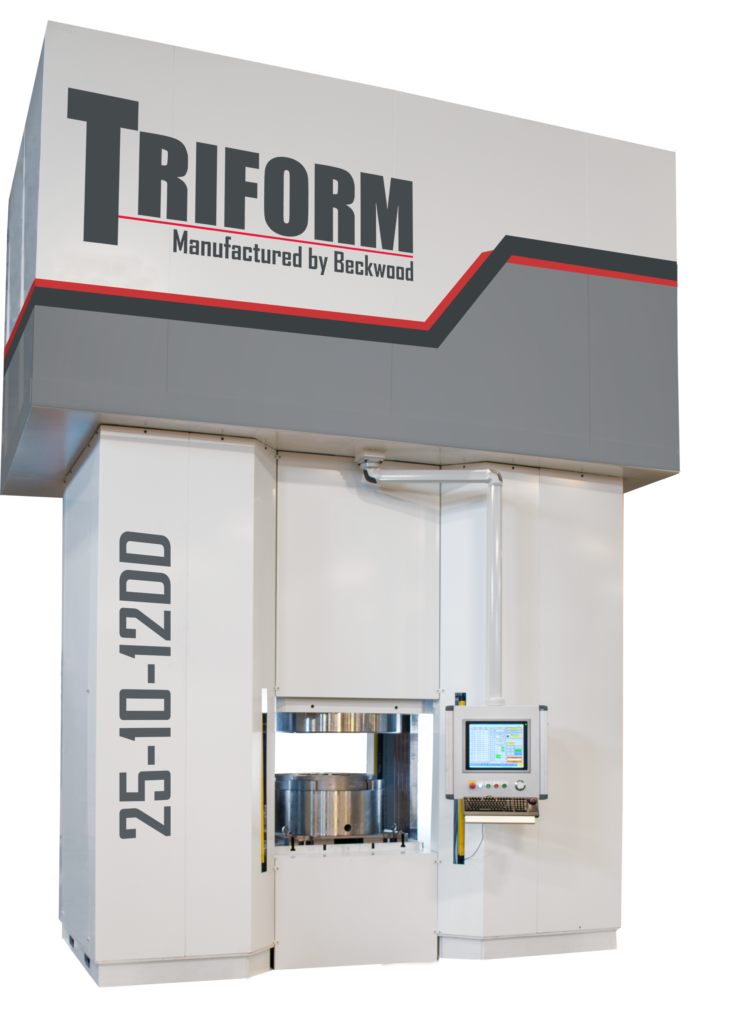
| 25-10-12DD | 25" | 10,000 | 12" | 19" | 750T | 36" |
| 25-15-12DD | 25" | 15,000 | 12" | 19" | 1450T | 52" |
| 32-10-12DD | 32" | 10,000 | 12" | 27" | 1170T | 60" |
| 42-10-12DD | 42" | 10,000 | 12" | 36" | 2023T | 72" |
FAQs
Triform FAQs
What is Sheet Hydroforming?
Hydroforming is defined as the process in which metal is shaped using fluid dynamics. Sheet Hydroforming, in particular, is a sheet metal forming process that utilizes a pressurized rubber bladder (diaphragm) to form sheet metal material over a single male or female tool. Unlike traditional stamping or deep drawing, which rely on rigid tooling, hydroforming offers a uniform distribution of pressure, allowing for the creation of complex, high-precision parts with minimal tooling and material waste.
What Are The Advantages of Sheet Hydroforming?
- Ability to Form Complex Shapes – The pressurized bladder can flow over intricate contours more easily than a rigid die, allowing for the forming of complex, asymmetrical, or compound-curved parts in a single operation. Similar parts in a traditional stamping or forming process often require multiple hits or intermediate anneals to achieve the same result.
- Lower Tooling Costs – With only a single, unmated male (or female in some cases) die, tooling costs are generally anywhere from 50%-90% less than conventional draw or stamping tooling.
- Flexibility for Short Runs – Hydroform tooling changeovers can range from 15 seconds (in fluid cell) up to ~10 minutes for larger deep draw machines, allowing for efficient, cost-effective high mix low volume operations.
- Unmatched Forming Performance – The sheet hydroform process generally allows for higher forming ratios (3:1 depth to diameter in some cases) without tearing. This process also minimizes material thinning, reduces springback, and provides a superior surface finish compared to traditional forming methods.
What Types of Sheet Hydroforming Are There?
The two primary types of TRIFORM sheet hydroforming presses are fluid cell and deep draw. Fluid cell presses create shallow parts over a single unmated tool typically with a net shape blank in many cases, while deep draw presses are used for drawn components, consisting of a punch that moves upward into the bladder during the forming process.
Is TRIFORM Right for My Application?
If you’re considering sheet or deep draw hydroforming for your manufacturing needs, start by answering these questions:
- Does my part geometry lend itself towards the fluid cell or deep draw process?
- Does my overall part size fit reasonably within the hydroform process?
- Do I anticipate high mix, lower volume production? While hydroform has been used for single part volumes up to 250,000 parts/year due to complex geometry/forming requirements, it is generally best suited for any given part number that is under 20,000 parts/year.
- Will the machine be dedicated to a single part or a variety of parts where inexpensive tooling and fast changeover is ideal?
- What alternative methods of forming are feasible and what are the overall pros & cons compared to sheet hydroforming?
Sheet hydroforming is a powerful forming process that provides significant benefits in a variety of landscapes, but it is not the best solution in every case. Contact Beckwood today with your forming challenges and opportunities to learn more.