

Deep Draw
Sheet Hydroforming
Home / Product Lines / Triform Presses / Deep Draw Sheet Hydroforming
Unmatched Forming Flexibility for Complex Parts
For High-Mix, Low-Volume Production
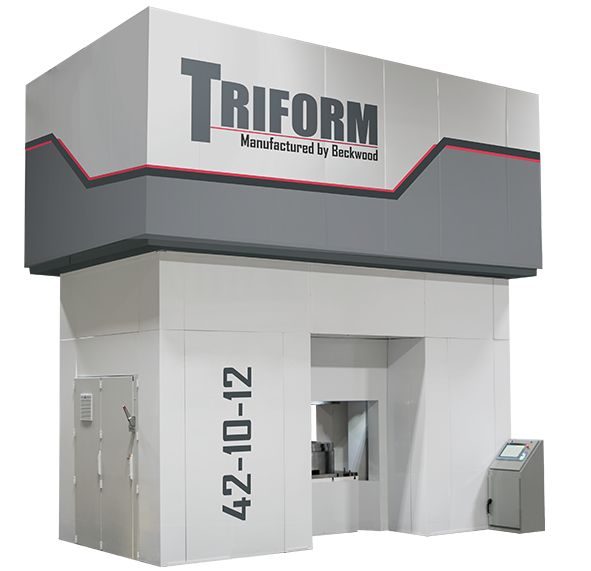
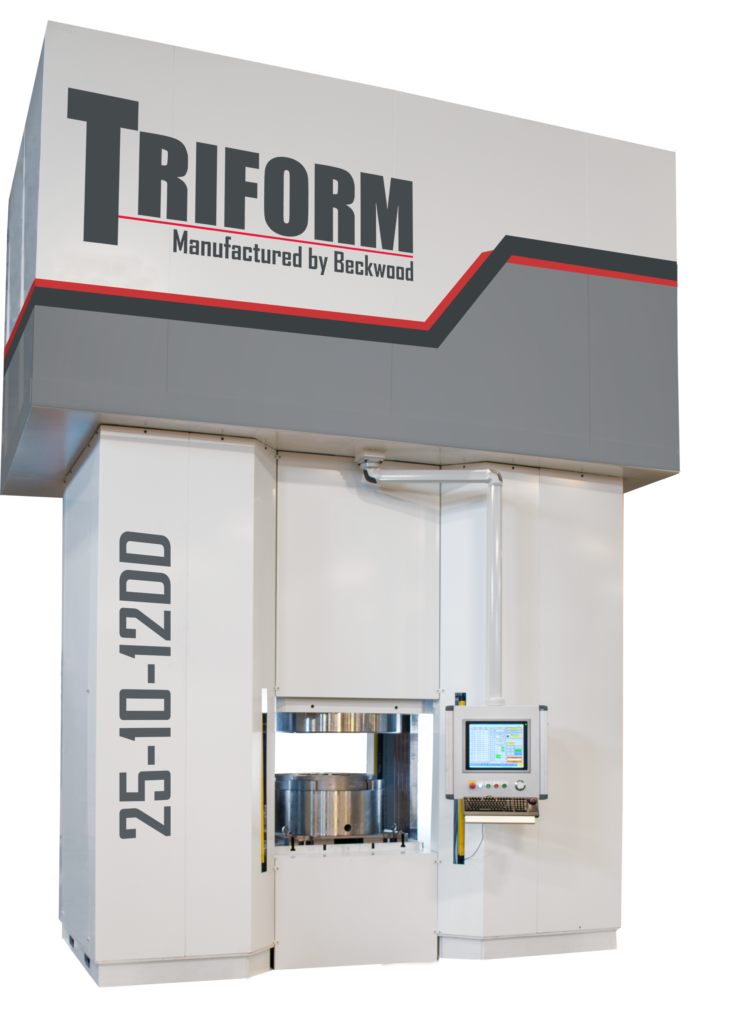
TRIFORM’s deep draw sheet hydroforming presses offer unmatched precision and draw depth. The strict control of material flow eliminates wrinkles and tears in parts like cans, boxes, and parts with curved flanges that commonly suffer from defects. Commonly found in aerospace, medical, and electronics manufacturing facilities, deep draw hydroforming machines are ideal for creating smooth, uniform, scratch-free parts with no secondary finishing required.
Explore Deep Draw Options
- Increased Lower Punch Force
- T-Table Tool Change
- Tool Adapters for Existing Tooling
- Increased Forming Pressure
- Punch Support Pins
- Barcode Scanner for Recipe Loading
- Custom Sizes Available Upon Request
Deep Draw
| Model | Max Blank Diameter | Max Forming Pressure (PSI) | Draw Depth | Max Punch Diameter | Punch Force | Pit Depth |
|---|---|---|---|---|---|---|
| 610-20-3DD | 6" x 10" | 20,000 | 3" | 3"x7" | 120T | N/A |
| 12-15-7DD | 12" | 15,000 | 7" | 8" | 280T | N/A |
| 16-10-7DD | 16" | 10,000 | 7" | 12" | 370T | N/A |
| 16-15-7DD | 16" | 15,000 | 7" | 12" | 600T | 19" |
| 20-10-10DD | 20" | 10,000 | 10" | 15" | 490T | 20" |
| 25-10-12DD | 25" | 10,000 | 12" | 19" | 750T | 36" |
| 25-15-12DD | 25" | 15,000 | 12" | 19" | 1450T | 52" |
| 32-10-12DD | 32" | 10,000 | 12" | 27" | 1170T | 60" |
| 42-10-12DD | 42" | 10,000 | 12" | 36" | 2023T | 72" |
Why Existing Hydroforming Users Choose TRIFORM

Eliminate reliance on displacement pressure:
While older Cincinnati and Verson deep draw hydroform machines rely on displacement pressure, TRIFORM technology provides the exact pressure you desire at the exact position you need it. This means you can form smaller parts on a larger machine and also replace both smaller and larger machines with a single new TRIFORM machine.

Eliminate intermediate anneal steps:
With the control and precision of both the punch position and pressures at those positions, it is common for TRIFORM customers to reduce the number of anneal steps by up to 50% or more, saving both time and cost.

Adapt to Existing Tooling:
Beckwood can review existing tooling set up and provide necessary draw ring and punch adapters to work seamlessly on a new TRIFORM, while still allowing for TRIFORM’s quick tool change method.

Increased lower punch force:
In some cases, the standard lower punch force on existing machines will not be sufficient to effectively form larger surface area tools at higher pressures. Beckwood can review desired parts and size the punch cylinder to ensure it provides adequate force to form without stalling or backing off throughout the cycle.

Reduce scrap & reliance on skilled labor:
Hydroforming on older equipment is an art. This makes it difficult to rely on consistent parts and also to train new operators within the workforce. A new TRIFORM machine eliminates this concern and provides a level of security looking to the future.

Control capabilities:
TRIFORM controls are designed with flexibility in mind and backed by decades of real-user feedback with real operational challenges. There are several programmable features included to allow operators to overcome existing challenges, all in a repeatable manner.

Why New Hydroforming Users Choose TRIFORM
For new users, the decision drivers differ from those of a company replacing older hydroform equipment. Oftentimes, the decision comes down to which process is the best fit when compared with traditional draw with mated tools, stamping, spinning, or even machining.
Lower Tooling Investment
When dealing with a high mix, low volume production landscape, deep draw hydroform provides a great solution to minimize tooling cost across a large variety of parts.
Versatile Part Production
Produce a wide range of part sizes, shapes, and materials on a single machine.
Superior Surface Quality
Eliminate metal to metal contact and the witness marks associated with mated die forming can significantly reduce costly secondary finishing.
Rapid Prototyping to production
Easily move from one-off prototypes to production runs without tooling changes.
Deep Draw Sheet Hydroforming FAQs
How Does Deep Draw Sheet Hydroforming Work?
The deep draw sheet hydroform process consists of an operator placing a sheet metal blank on the draw ring surface. Once the press closes, the male punch will move upward into the bladder while the bladder simultaneously generates the desired amount of forming pressure at each step or punch height. Once the forming is complete, the bladder will decompress, the machine will open, and the punch will retract to strip the part for removal. Each part recipe (or program) is pre-developed and saved for easy recall and includes individual steps consisting of desired:
- Punch Position
- Forming Pressure (psi)
- Dwell Option
- TRIFORM’s “Open Feature”
Deep draw sheet hydroform machines not only perform deep draw work, but can serve a variety of purposes. These machines can also be used as a fluid cell hydroform or bulge forming, providing the ultimate forming flexibility.