
Stretch Forming
Home / Press Applications / Stretch Forming
Ideal for Precision Structural Metalforming
Stretch forming is a metal forming process that uses controlled tension to wrap material over a contoured form die, producing smooth, accurate curves with minimal springback. By placing the material in tension during forming, stretch forming enables complex geometries to be created in a single cycle while preserving surface finish and dimensional consistency. The process is widely used to form long structural profiles, extrusions, and large contoured panels where part accuracy and repeatability are critical. Stretch forming is most commonly applied in aerospace, transportation, and architectural manufacturing environments.
Stretch Forming Processes: Extrusion vs Sheet
Extrusion Stretch Forming
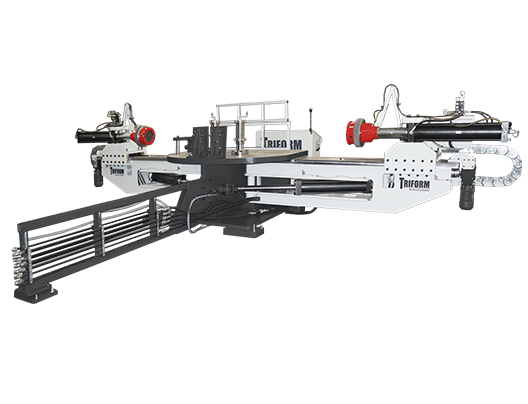
Extrusion stretch forming is used to shape long, constant-cross-section profiles by clamping the extrusion at each end and wrapping it around a contoured form die under controlled tension. The material is stretched beyond its elastic limit during forming, allowing it to conform to the die while minimizing springback.
This process is most commonly used for aluminum extrusions in aerospace applications such as wing stringers, spars, frames, chords, and other structural components. Extrusion stretch forming is well suited for long parts, tight radii, and repeatable high-accuracy forming in low- to medium-volume production environments.
Sheet Stretch Forming
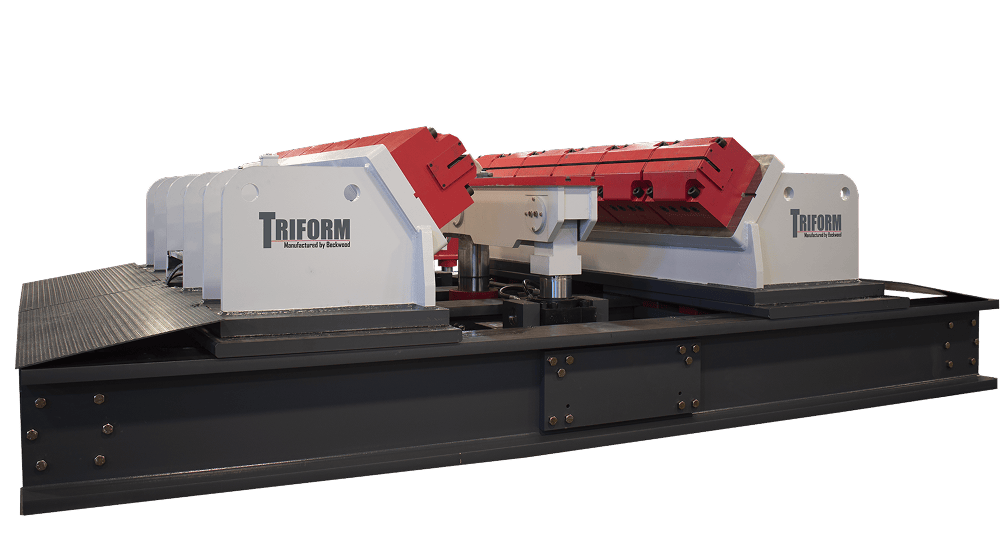
Sheet stretch forming equipment forms flat sheet material over a contoured die using gripping jaws to apply tension along the edges of the sheet as the die moves into the material. This process is typically used to form large panels or skins with smooth curvature rather than deep features.
Stretch Forming Machine Design
The following information is typically required to accurately size and quote a stretch forming system:
Extrusion Stretch Forming
- Maximum part length (prior to stretching)
- Minimum part length
- Required forming force, based on both the largest and smallest cross-sectional area parts
- Die table size
- Jaw size (commonly 4”, 6”, 8”, 10”, or 12”)
Sheet Stretch Forming
- Part dimensions
- Die table dimensions and tooling mounting requirements
- Required die table force
- Maximum and minimum distance between jaws
- Additional motion requirements such as jaw swing, rotation, oscillating carriage motion, die table tilt
FAQs
Stretch Forming
What is stretch forming used for?
Stretch forming is used to create smooth, accurate curves in long extrusions and large panels, commonly for aerospace structural components, skins, frames, and architectural profiles.
What is the difference between extrusion stretch forming and sheet stretch forming?
Extrusion stretch forming shapes long profiles with a constant cross section by wrapping them around a die under tension, while sheet stretch forming forms flat sheets into contoured panels using edge gripping and die motion.
Why is stretch forming often performed in a single cycle?
By stretching the material beyond its elastic limit, stretch forming minimizes springback and allows complex curvature to be achieved in a single forming operation.
Can modern stretch forming machines replace legacy Hufford equipment?
Yes. TRIFORM stretch forming machines are commonly engineered to replace legacy Hufford equipment while maintaining compatibility with existing tooling and improving control, repeatability, and safety.
What materials are commonly stretch formed?
Aluminum alloys are the most common materials, though other ductile metals can be stretch formed depending on elongation characteristics and application requirements.
Can Beckwood customize a stretch forming machine for my application?
Yes. Beckwood designs custom stretch forming systems tailored to specific materials, part lengths, curvatures, production volumes, and facility constraints.