
Assembly
Press
Home / Press Applications / Assembly Presses
Standalone Solutions & Automation Integrations
Assembly presses are used to join, seat, stake, or install components with controlled force and motion to ensure consistent fit, function, and quality. These presses are commonly used for press-fit operations, bearing installation, bushing insertion, staking, swaging, and other assembly processes where precise force control and repeatability are critical. Assembly presses support both manual and automated production environments across aerospace, defense, automotive, appliances, medical, energy, and industrial manufacturing applications.
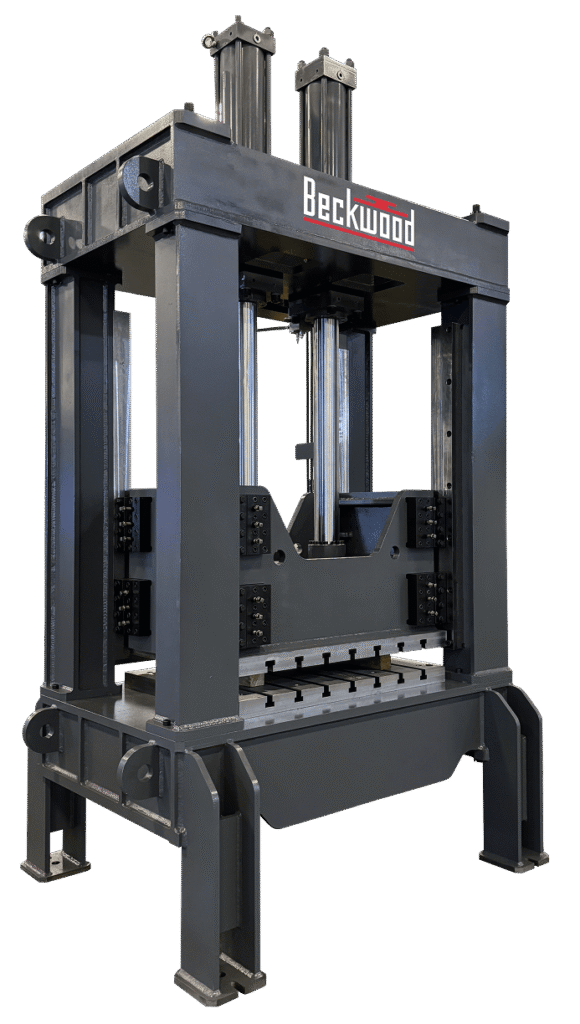
Assembly Press Design & Engineering Considerations
Assembly press design is driven by part geometry, fit requirements, allowable force variation, and production objectives. These considerations influence press capacity, control strategy, feedback requirements, and automation level.
Part Geometry & Fit Requirements
Component geometry, interference fit, and alignment requirements directly impact required force, stroke length, and guidance accuracy. Misalignment or inconsistent motion can result in part damage, scrap, or reduced product life.
Force, Position & Process Control
Many assembly operations require precise control of force, position, or both. Monitoring force-versus-position profiles during each cycle can be critical to verifying proper assembly, detecting defects, and ensuring consistent quality.
Repeatability & Quality Verification
Assembly presses are often used in quality-critical applications where every cycle must meet defined criteria. Process monitoring, data capture, and go/no-go functionality help verify assembly integrity and support traceability requirements.
Press Capacity & Speed
Required tonnage and cycle speed depend on part size, fit tolerance, and production rate. Assembly presses are typically sized to deliver controlled force rather than maximum speed, particularly for precision or fragile components.
Guidance, Alignment & Off-Center Loading
Off-center loading can occur due to part geometry or tooling layout. Press guidance systems must maintain alignment and repeatability under these conditions to protect tooling and ensure consistent assembly results.
Automation & Operator Interaction
Assembly processes may be manual, semi-automated, or fully automated. Press design must accommodate ergonomic considerations, part presentation, and integration with conveyors, robots, or other automation systems.
Beckwood Assembly Solutions
Beckwood engineers and manufactures a wide range of both standard and custom servo-electric and hydraulic assembly press systems designed to deliver precision, repeatability, and flexibility across diverse assembly applications.

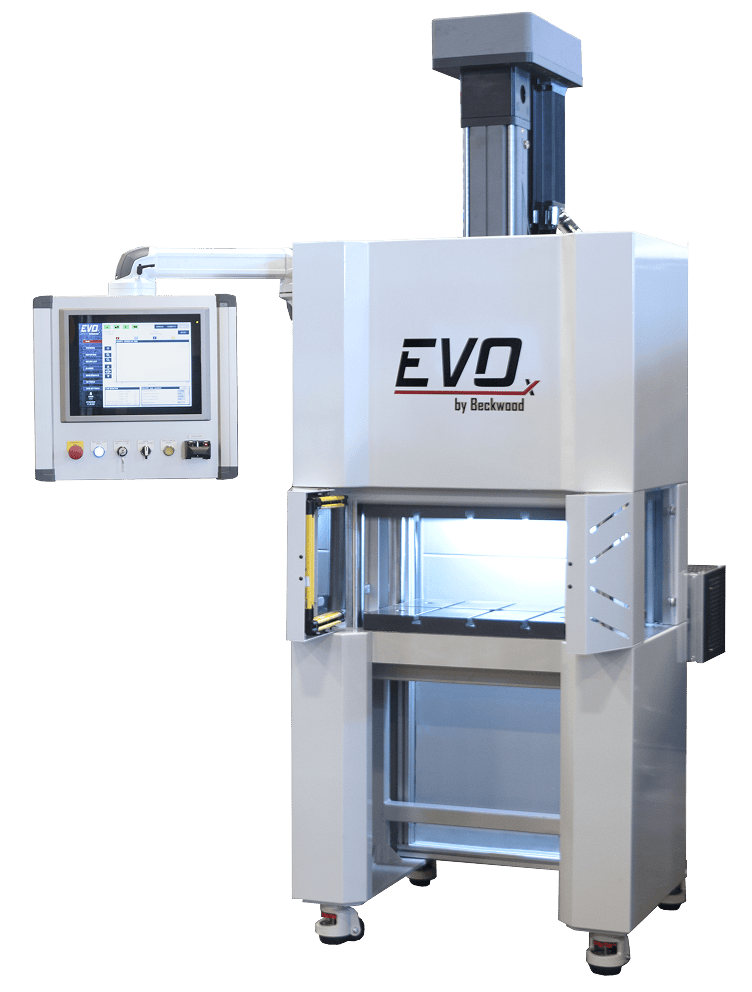
EVOx Servo-Electric Assembly Presses
EVOx servo-electric presses, ranging from 2.5 – 50 tons, provide precise force and position control with high repeatability, energy efficiency, and clean operation. These presses are well suited for precision assembly, press-fit, and quality-critical applications where detailed process monitoring and data collection are required.

Ascent Standard Hydraulic Presses
Ascent press systems offer scalable force capacities and modular configurations for higher-force assembly applications up to 400 tons. These systems combine adjustable pressing speeds with robust 8-point gib guided frame design, making them suitable for both standalone and integrated automation environments.

Custom Beckwood Assembly Presses
For applications requiring specialized force ranges, tooling, or automation, Beckwood designs custom assembly press systems tailored to specific production requirements. Custom solutions may incorporate unique guidance systems, multi-axis configurations, or integration with complex assembly lines.

Advanced Controls & Recipe Programming
Press controls support programmable force, position, speed, and dwell profiles, as well as recipe-based setups to ensure repeatability across part numbers. Data acquisition and process monitoring support quality verification and traceability.

Automation & System Integration
Assembly presses can be integrated with robotic handling, part feeding systems, vision inspection, and downstream operations to support automated and semi-automated production workflows.
Assembly FAQ
What types of operations are typically performed on assembly presses?
Assembly presses are commonly used for press-fit, bearing and bushing installation, staking, swaging, riveting, and component seating operations.
When is a servo-electric assembly press preferred over hydraulic?
Servo-electric presses are often preferred for applications requiring precise force and position control, energy efficiency, and clean operation. Hydraulic presses may be selected for higher-force or more rugged assembly environments.
How is quality verified during an assembly operation?
Quality is commonly verified by monitoring force-versus-position curves, cycle completion criteria, and go/no-go limits, with data captured for traceability when required.
Can assembly presses be automated?
Yes. Assembly presses are frequently integrated into automated assembly lines with robotic loading, part feeding, and inspection systems.
What industries use assembly presses?
Beckwood assembly press systems are used across aerospace, defense, automotive, appliances, medical, energy, and industrial manufacturing applications.
Can Beckwood customize an assembly press for my application?
Yes. Beckwood specializes in custom-engineered assembly press solutions tailored to specific components, force requirements, production volumes, and facility constraints.