
Rubber Pad Forming
Home / Press Applications / Rubber Pad Forming
Create Near-Net Parts With Low Tooling Costs
Rubber pad forming, also known as Guerin forming or elastoforming, is a sheet metal forming process that uses a flexible rubber or urethane pad as a universal die half to form material over a single, un-mated tool. During forming, the rubber pad applies pressure to the sheet, conforming it to the tool geometry without the need for matched tooling. This process is well suited for low-volume, high-mix production where tooling cost, speed of development, and flexibility are prioritized over tight tolerances or net-shape results. Rubber pad forming is commonly used in aerospace, defense, industrial, and prototype manufacturing environments.
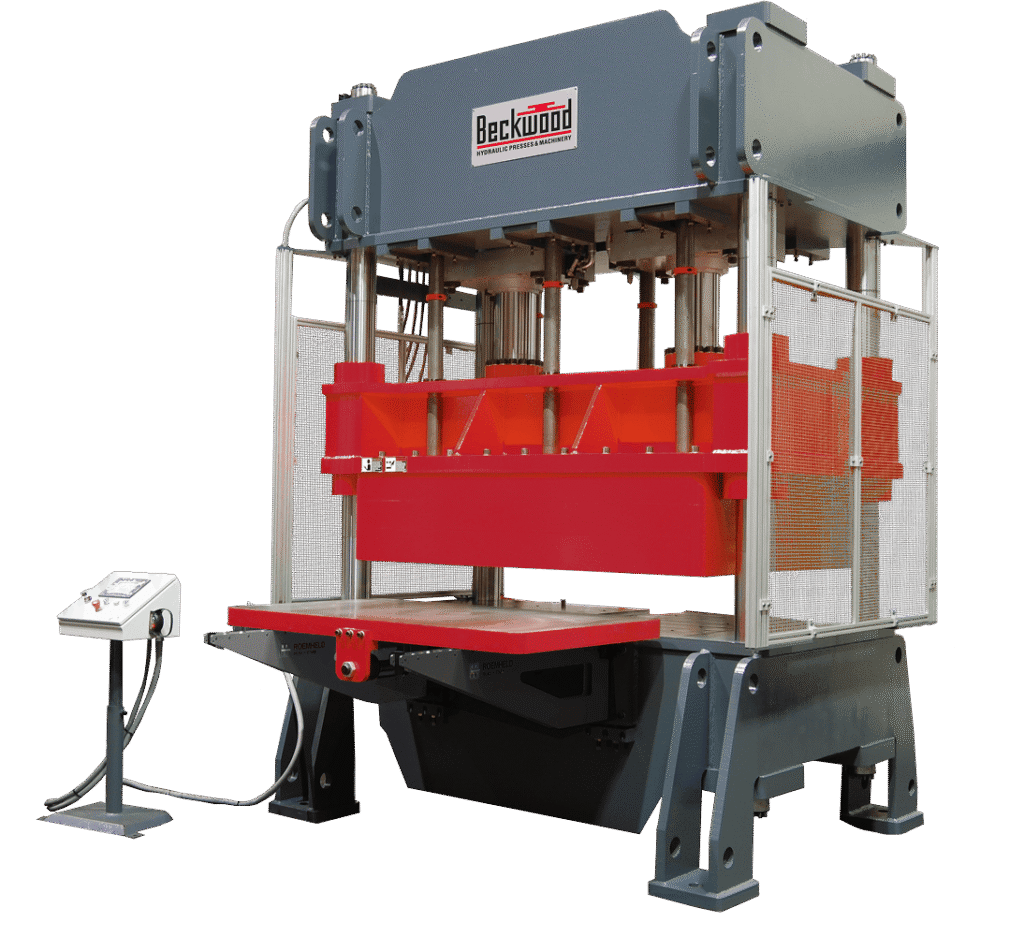
How We Design Rubber Pad Forming Presses
Rubber pad forming press design is driven by part geometry, material type, required forming depth, and production objectives. These considerations influence press tonnage, pad box design, tooling strategy, and overall system configuration.
Part Geometry & Forming Limits
Rubber pad forming is best suited for shallow to moderate-depth parts with relatively simple geometries. As forming depth increases or features become more complex, material thinning, loss of definition, and secondary finishing requirements become more likely.
Tooling Strategy & Cost
One of the primary advantages of rubber pad forming is the ability to use low-cost, single-sided tooling. Tools can be produced quickly from materials such as steel, aluminum, epoxy, composite substrates, 3D-printed materials, or wood. This significantly reduces upfront tooling cost and supports rapid iteration.
Rubber Pad & Pad Box Design
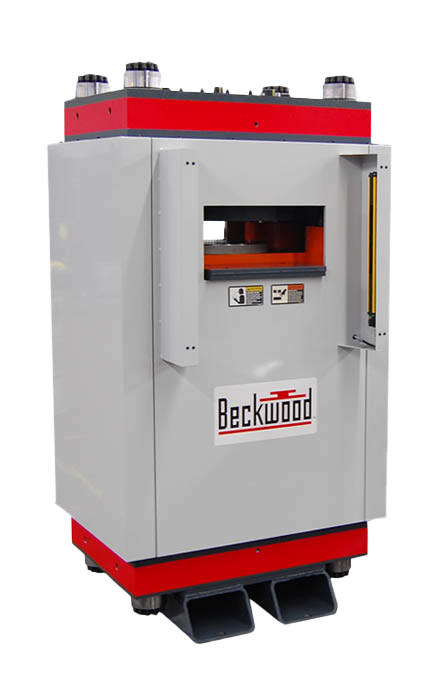
Pad material, hardness, thickness, and containment design influence pressure distribution, part definition, and pad life. Fully enclosed pad boxes prevent rubber extrusion and support consistent forming. The general rule of thumb Beckwood utilizes for pad box stackup is 3X the max tool height to protect pad surfaces from premature wear.
Production Volume & Changeover
Rubber pad forming is well suited for high-mix environments because of the ability to form multiple identical or different parts in a single cycle (provided they fit within the forming area). Minimal setup and fast changeover further support efficient low-volume production.
Secondary Operations & Finishing
Due to the nature of rubber pad forming and the majority of pressure being exerted on top of the part vs uniform pressure in sheet hydroform, parts produced by rubber pad forming may require secondary hand finishing on complex geometries. Other secondary operations may include trimming, straightening, or finishing operations to achieve final dimensional or surface requirements.
Beckwood Rubber Pad Solutions
Beckwood engineers and manufactures custom hydraulic rubber pad forming presses designed to deliver flexible, cost-effective forming for low-volume and high-mix applications. For applications under 400 tons, the standard Ascent hydraulic press line offers a wide range of forming areas with the addition of a pad box, minimizing overall lead time.

Custom Beckwood Rubber Pad Presses
Custom press systems designed specifically for rubber pad forming, with optimized tonnage, bed size, and stroke to support forming requirements while protecting tooling and pads.

Ascent Standard Hydraulic Presses
Ascent preconfigured press designs range from 100 to 400 tons with a variety of size options. With the addition of a pad box, this is a common approach to meeting rubber pad forming needs with a predesigned system to minimize lead times.

Retrofit & Integration Options
Rubber pad boxes can be supplied as standalone systems for integration with existing hydraulic presses, providing a cost-effective entry point into rubber pad forming.

Bed Shuttle Options for Loading/Unloading
For larger forming areas, bed shuttles can be provided for easy and ergonomic loading and unloading of tooling and parts.
Rubber Pad FAQ
What materials are commonly formed using rubber pad forming?
Rubber pad forming is commonly used with aluminum, mild steel, stainless steel, and other ductile sheet materials, depending on part geometry and thickness.
What are the main advantages of rubber pad forming?
Key advantages include low tooling cost, fast tool fabrication, quick changeover, and the ability to form multiple parts in a single cycle.
What are the limitations of rubber pad forming?
Rubber pad forming is generally limited to shallow or moderately complex geometries and may require secondary finishing operations. It is not typically used for high-volume or net-shape production.
How does rubber pad forming compare to sheet hydroforming?
Sheet hydroforming offers more uniform pressure distribution and improved part definition, often enabling net-shape results with fewer secondary operations. Rubber pad forming typically has lower upfront cost but may require additional finishing.
Can Beckwood customize a rubber pad forming press for my application?
Yes. Beckwood designs custom rubber pad forming press systems tailored to specific part sizes, materials, production volumes, and facility requirements.