
Powder Compacting
Home / Press Applications / Powder Compacting
What is Powder Compaction?
Powder compacting, also called powder compaction, is a forming process used to produce dense, near-net-shape parts by applying controlled force to metallic, ceramic, polymer, or other powder materials within a rigid die. The process relies on precise control of fill depth, compaction force, and ejection to achieve uniform density and dimensional consistency. Powder compaction is commonly used for applications requiring tight tolerances, high material utilization, and repeatable part quality. It supports both low-volume development and high-volume production across aerospace, defense, medical, automotive, energy, agricultural, construction, and industrial manufacturing environments.
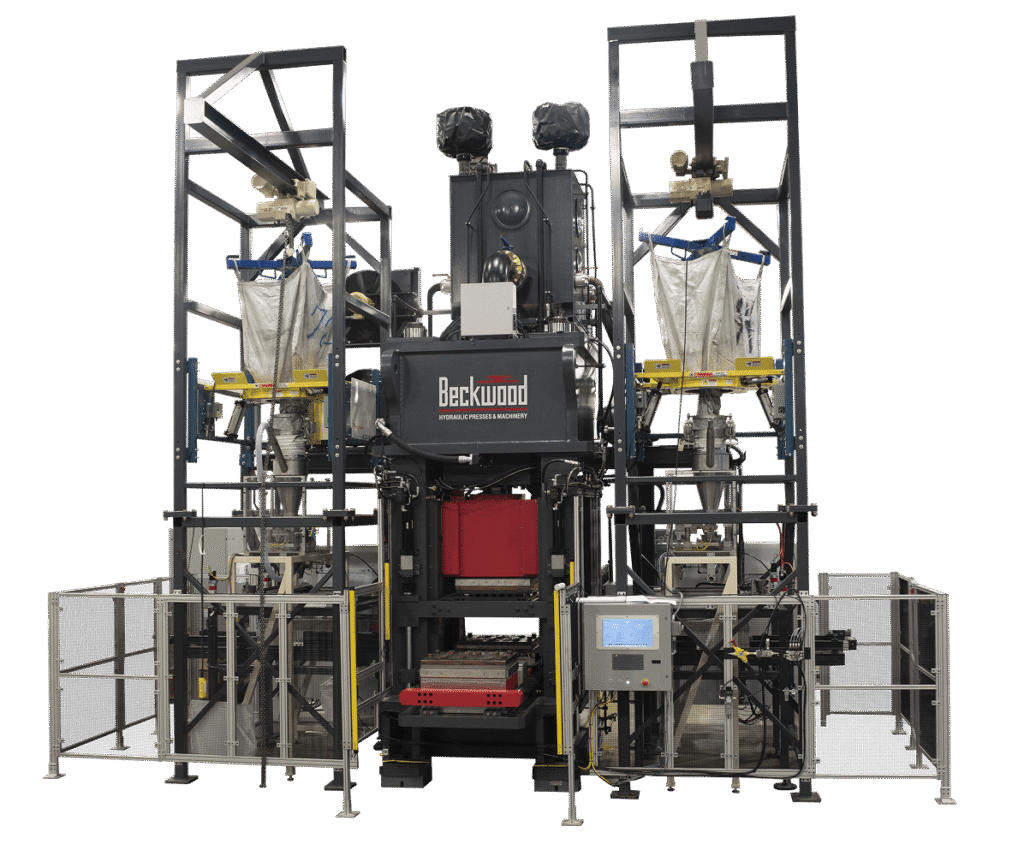
Custom Powder Compaction Press Design & Engineering Process
Powder compaction press design is driven by material characteristics, part geometry, density requirements, and production objectives. These considerations influence press configuration, number of actions, force capacity, controls, and automation strategy.
Material Type
Powder composition, particle size, flow behavior, and compressibility directly affect compaction force, fill consistency, and achievable density. Metallic, ceramic, polymer, PTFE, and composite powders each require different compaction and ejection strategies.
Part Geometry & Density Requirements
Part size, thickness, aspect ratio, and target green density influence press tonnage and tooling design. Uniform density is critical to minimize distortion, cracking, or defects during ejection and downstream processes such as sintering.
Press Configuration
Many powder compaction applications require multi-action or triple-action presses to independently control powder filling, compaction, and part ejection. These configurations improve density uniformity, reduce internal stresses, and minimize tooling and part damage.
Fill Depth & Powder Distribution
Powder filling is typically controlled by either volume or weight, depending on material characteristics and part requirements. Volume-based filling relies on consistent cavity depth and powder flow behavior, while weight-based filling uses controlled dispensing to achieve precise part mass. Accurate control of fill depth and distribution is essential to achieving consistent part weight and density. Multi-action press configurations allow independent control of cavity depth and compaction force to support repeatable powder distribution across either filling method.
Ejection & Tooling Protection
Controlled ejection is critical to prevent cracking or damage to green parts. Ejection force, speed, and alignment must be carefully managed to protect both the part and tooling, particularly for high-density or fragile compacts.
Production Rate & Automation
Production volumes influence press speed, automation level, and system integration. Automated powder weighing, filling, and leveling can improve consistency and reduce operator variability in high-volume environments.
Beckwood Powder Compacting Solutions
Beckwood engineers and manufactures custom hydraulic and servo-electric powder compaction press systems designed around the specific material, tooling, and configuration requirements of each application. Capabilities include:

Multi-Action Powder Compaction
Multi-action press configurations provide independent control of cavity depth, compaction force, and part ejection to achieve uniform density and consistent part quality.

High-Force Hydraulic Press Systems
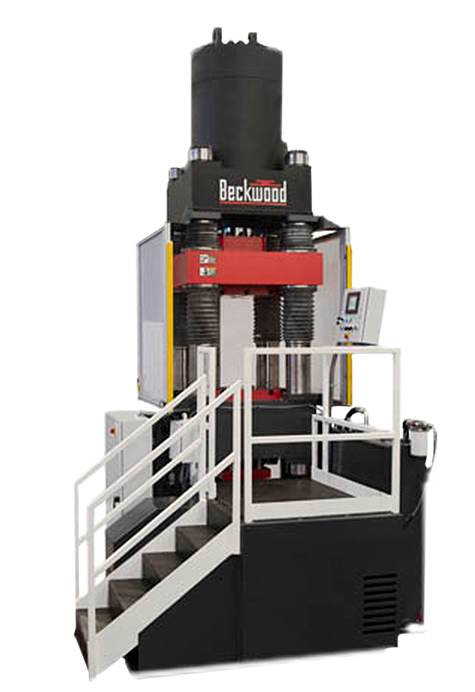
Custom hydraulic press designs are capable of delivering very high compaction forces over small working areas with precise force and position control throughout the compaction cycle.

Servo-Electric Powder Compaction Press Systems
Servo-electric powder compaction presses offer precise motion and force control with high repeatability, energy efficiency, and clean operation. They are typically used for lower to mid-tonnage applications, but are available up to 500 tons where tight control of fill, compaction, and ejection is required.

Automated Powder Handling Integration
Beckwood systems can be provided with automated powder weighing, dispensing, filling, leveling, and powder shoe or hopper systems to improve consistency and throughput.

Heated Platens & Thermal Control
Optional heated platens with precise temperature control help support certain powder systems, improve green strength, or support temperature-sensitive compaction processes prior to downstream sintering.

Advanced Controls & Cycle Programming
Presses can be loaded with step-by-step programming of fill position, compaction force, dwell, decompression, and ejection profiles. Recipe functionality and data acquisition support repeatable production and process validation.
Powder Compacting FAQ
What materials are commonly processed using powder compaction?
Powder compaction is used for a wide range of materials, including metallic powders (iron, steel, stainless, and specialty alloys), ceramics, polymers, PTFE, HDPE, UHMW-PE, and composite powder systems. Material characteristics such as particle size, flowability, compressibility, and green strength influence press configuration, tooling design, and required compaction force.
How is powder typically filled into the die?
Powder filling is typically controlled using either volume-based or weight-based methods. Volume filling relies on consistent cavity depth and predictable powder flow, while weight-based filling uses controlled dispensing to achieve precise part mass. The appropriate method depends on material behavior, density requirements, and part tolerances.
Why are multi-action or triple-action presses commonly used for powder compacting?
Multi-action presses allow independent control of powder fill depth, compaction force, and part ejection. This improves density uniformity, reduces internal stresses, and minimizes cracking or damage during ejection, particularly for thicker parts or materials with lower green strength.
Can powder compaction presses be automated?
Yes. Powder compaction presses are frequently integrated with automated powder weighing, filling, leveling, part handling, and inspection systems. Automation improves repeatability, reduces operator variability, and supports higher production rates.
What industries use powder compacting presses?
Beckwood powder compacting press systems are used across aerospace, defense, medical, automotive, energy, construction, and general industrial manufacturing applications.
Can Beckwood customize a powder compaction press for my application?
Yes. Beckwood specializes in custom-engineered powder compaction press solutions tailored to specific materials, part geometries, density requirements, production volumes, and facility constraints.